
The counter AI proof platform.
Digital content is being created, copied, edited, and reposted at unprecedented speed.
Who created it?
When did it exist?
Has it been changed?
Can its origin be verified later?
Etymon helps answer these questions by giving creators, professionals, and organizations a way to create cryptographically verifiable records of their digital content.
Authenticity needs more than trust
Today, almost anyone can create realistic images, videos, audio, documents, and other digital materials using accessible tools.
At the same time, original work can be copied, modified, misattributed, or taken out of context with equal ease.
There will always be bad actors who try to pass off altered or synthetic content as authentic.
Etymon is built for good actors: creators, researchers, journalists, developers, and professionals who want a reliable way to prove that their content existed at a specific point in time - and that the file being verified matches the original record.
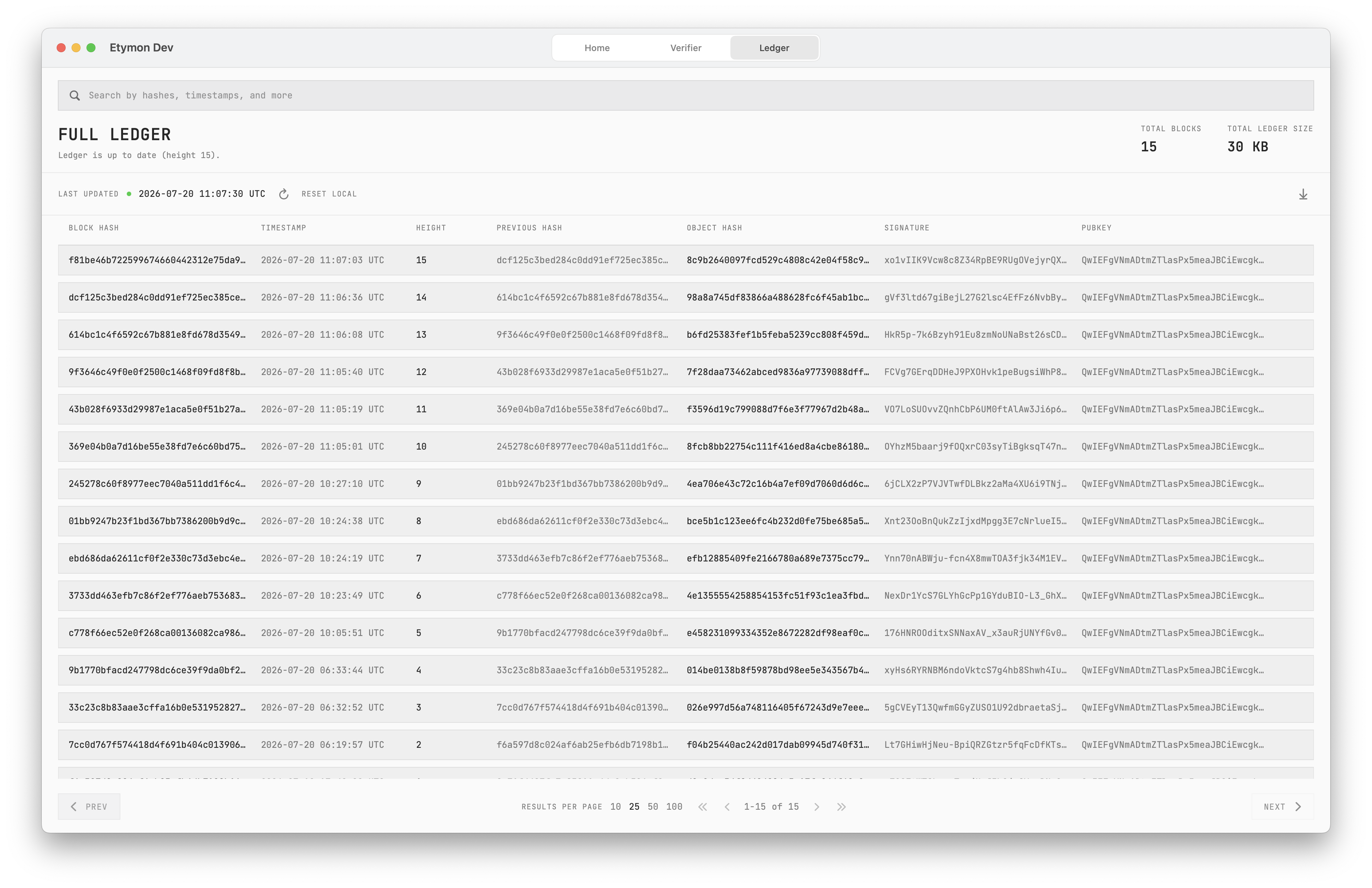
See the public ledgerProving origin without giving up control
Many systems for proving digital content require the content itself to be published, uploaded to a platform, or exposed through metadata.
Etymon takes a different approach.
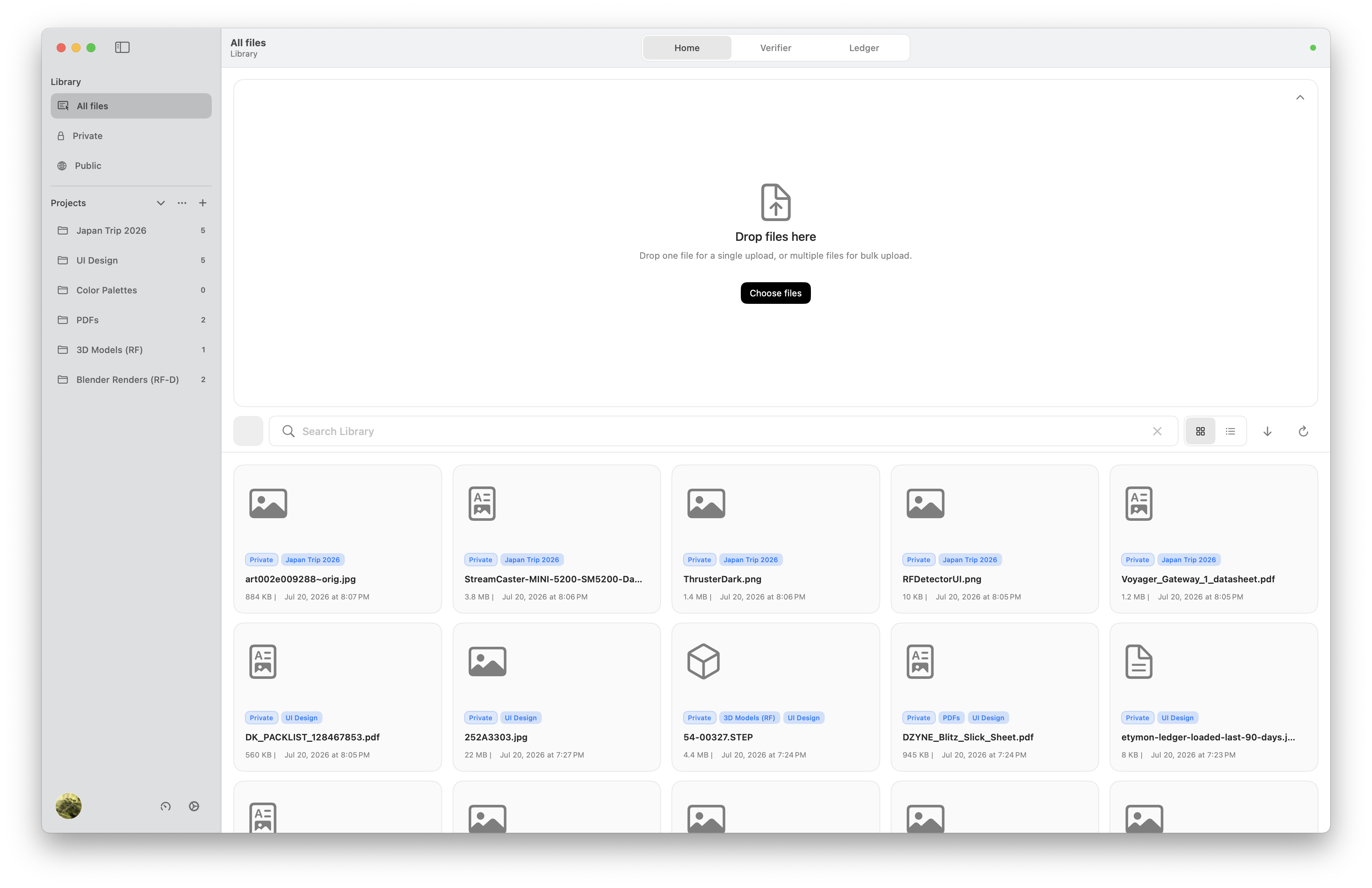
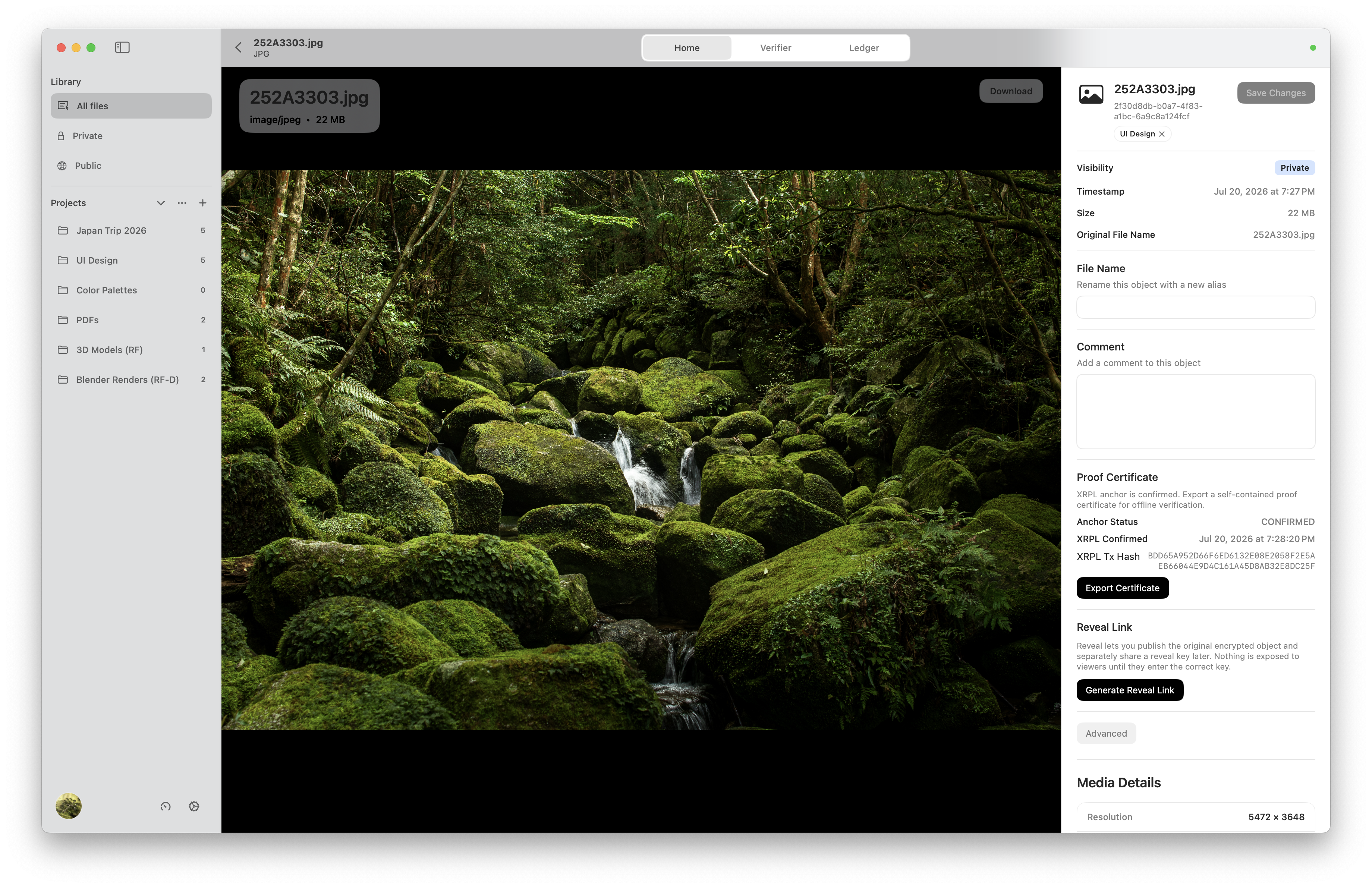
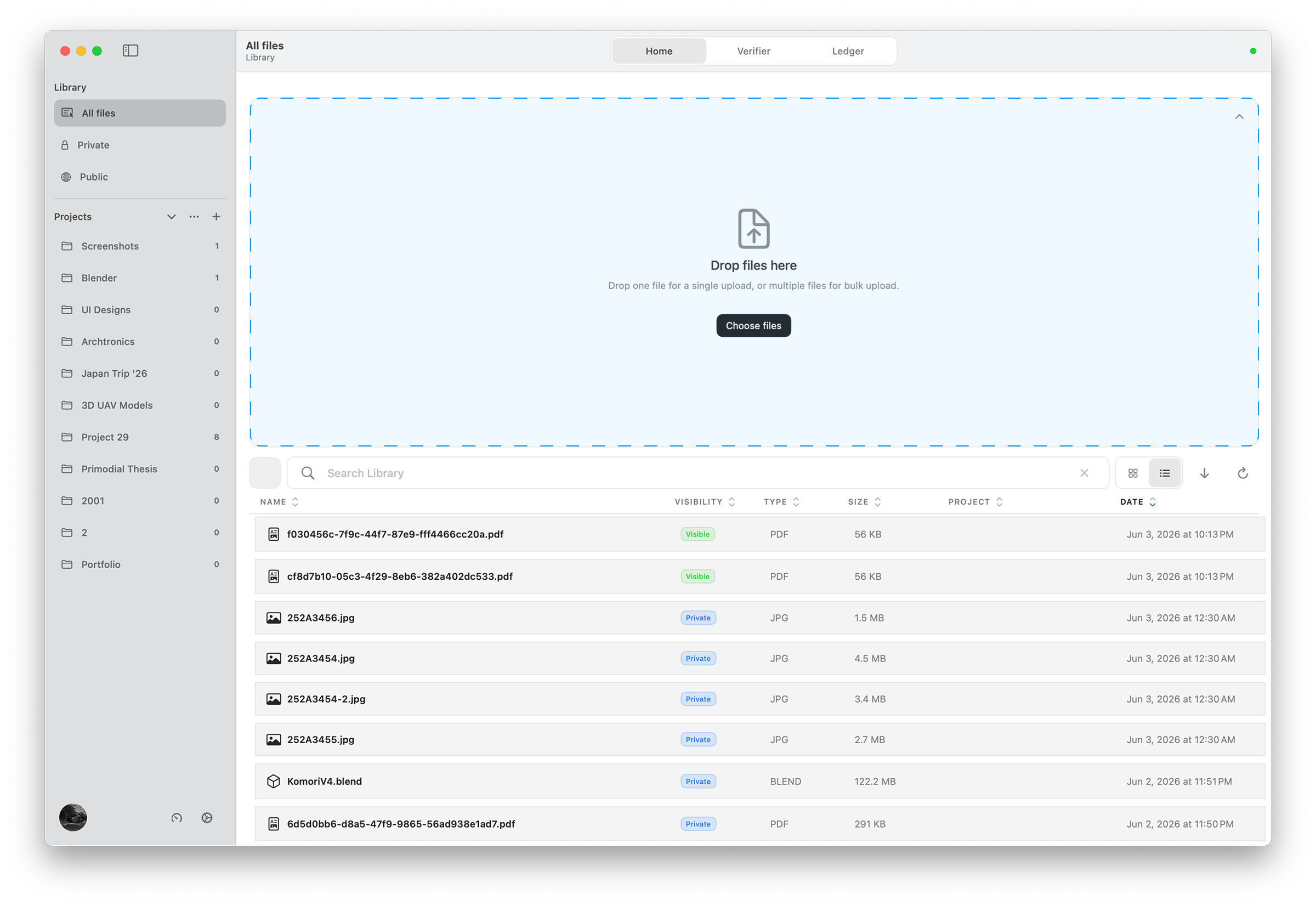
With Etymon, the original file is encrypted by the app before it is stored. The system creates a verifiable record from the file's digital fingerprint, timestamp, and integrity data without making the original available to the public.
If the creator later chooses to share it, the app prepares a separate publication on their device and encrypts it with a new key. The original and its key remain separate from the shared copy.
This means you can prove the existence and integrity of a work without disclosing it, then share a separately protected copy when you choose.
Verification Beyond Platform Trust
Social media timestamps, cloud upload dates, and platform records can be useful. But posts can be deleted, accounts suspended, metadata stripped, and platforms can change or disappear.
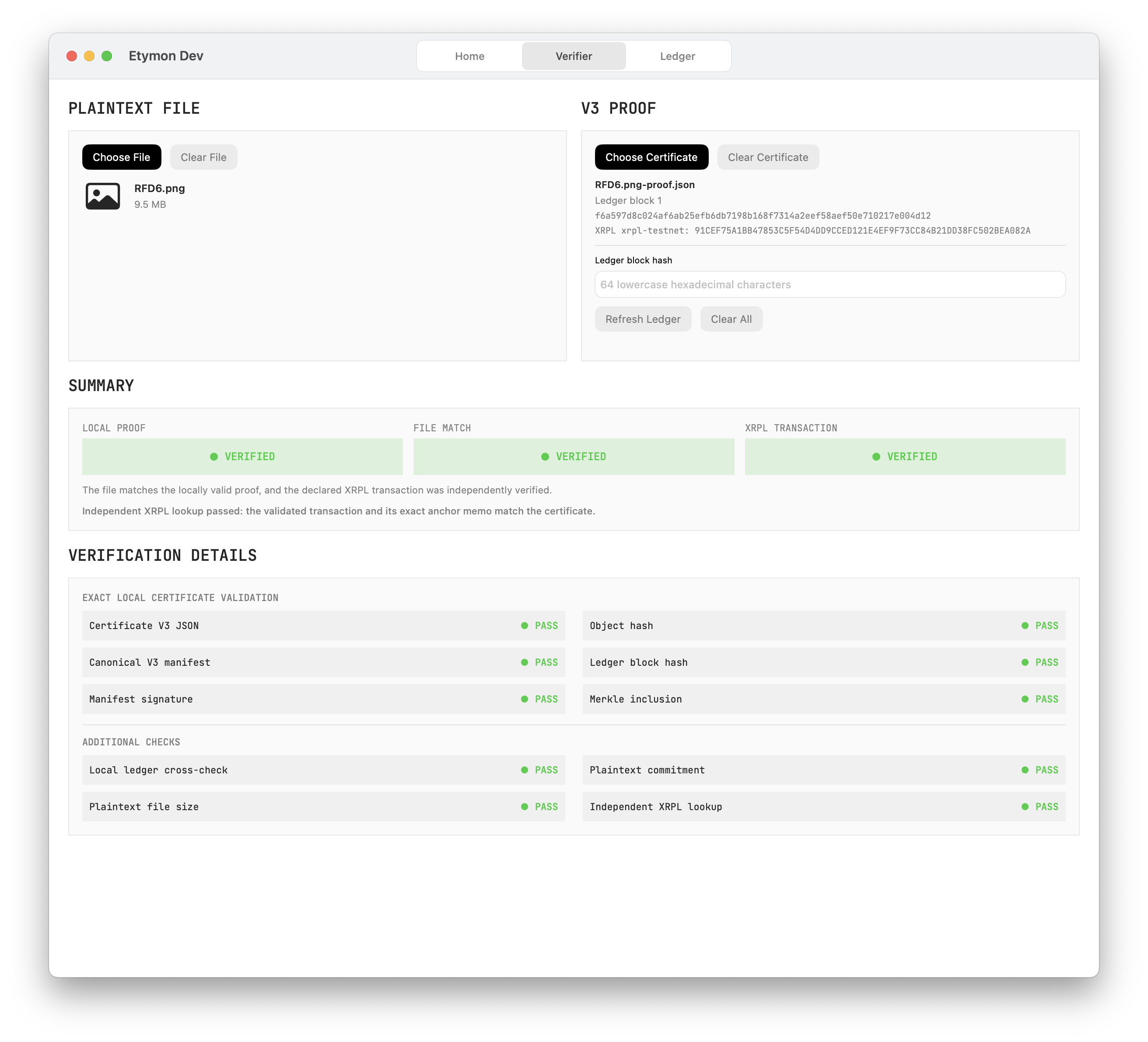
Etymon creates cryptographic records that can be checked independently. Each registered file can later be verified to show when it existed and whether it has changed since registration.
The goal is not just to store content.
The goal is to make content verifiable.
Explore how to verifyUsed by Professionals, Researchers, and Creators
Whether you're protecting intellectual property or establishing research integrity,
Etymon provides tamper-evident, timestamped proof of authorship.
For creators, this can support proof of authorship and first publication.
For researchers, it can help preserve the integrity of experimental records and drafts.
For journalists and photographers, it can help protect the origin and context of important media.
For organizations, it can provide a stronger audit trail for critical digital assets.



Built for an AI-generated world
As AI-generated and AI-edited content becomes ordinary, the internet needs more than visual judgment or platform labels. It needs verifiable records that can survive copying, reposting, editing, deletion, and dispute.
Etymon gives people a way to create those records before they are needed.
Because once a dispute begins, it is too late to go back in time and create evidence.
Etymon helps you preserve proof at the moment your content matters, so that, later, you can show what existed, when it existed, and whether it has changed.
Available for macOS 15.2+
What is Etymon?
Etymon is a service for creating verifiable records of digital files - showing who had what content, and when.
When you register a file such as an image, document, PDF, contract, research dataset, design file, or source code, Etymon generates cryptographic proof data from that file and records it in a tamper-resistant way.
Etymon is not just cloud storage. Its purpose is not merely to keep files online, but to help you prove later that a specific file existed at a specific point in time and has not been altered since registration.
What can Etymon prove?
Etymon can technically help demonstrate things such as:
- A specific file existed at a particular point in time
- A file presented later matches the file that was originally registered
- The file has not been altered since registration
- Which account or device registered the file
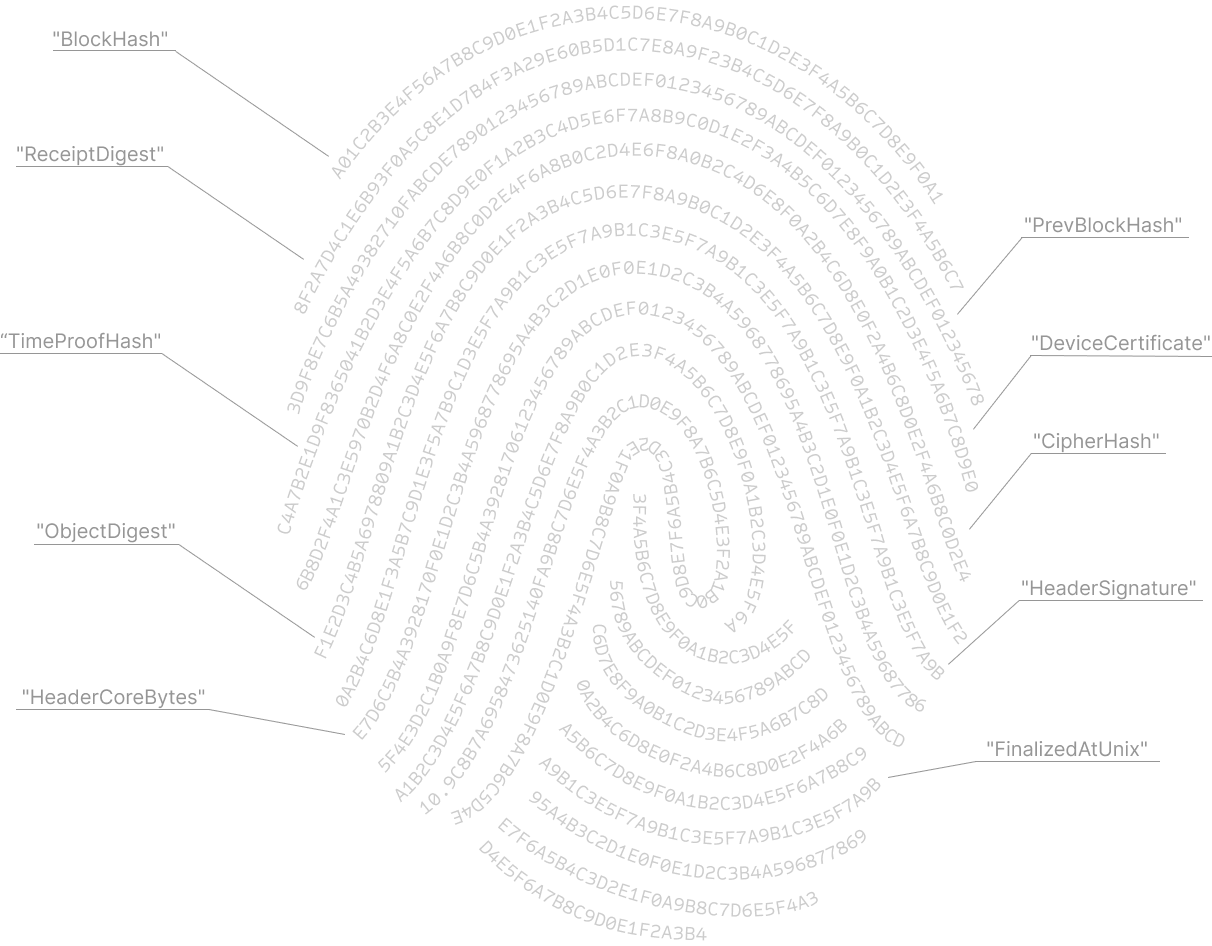
- Whether the proof record is consistent with the public ledger and external blockchain anchors
In other words, Etymon helps answer two important questions about digital files: "When did this file exist?" and "Is this still the same file?"
What can Etymon not prove?
Etymon provides verifiable technical evidence, but it does not prove everything.
Etymon alone does not conclusively prove:
- Who legally owns the copyright
- Whether the content is true
- Whether the file infringes someone else's rights
- Whether the registrant is the rightful owner
- Any final legal, administrative, or judicial conclusion
Etymon provides verifiable technical proof, not a final legal judgment.
Legal rights and evidentiary value may depend on the laws of the relevant country or region, the surrounding facts, contracts, and decisions by courts, authorities, or other qualified professionals.
Is Etymon the same as copyright registration?
No. Etymon is not an official copyright registration system.
Copyright registration is a legal process defined by the laws and institutions of each country or region. Etymon, by contrast, is a technical system that helps prove that a digital file existed at a certain point in time and that a file presented later matches the original registered content.
Etymon is not a replacement for copyright registration. Instead, it can complement copyright registration, contracts, creation logs, publication records, and other forms of evidence.
For example, creators can register drafts, illustrations, photographs, music files, source code, proposals, and other works during the creation process. If a dispute arises later, Etymon may help show that you had that specific content at that specific time.
Are files themselves stored on the blockchain?
No. Etymon does not normally store the actual file contents on a blockchain.
Instead, Etymon records cryptographic proof data generated from the file. This proof data can be used later to verify whether a file matches the original registered file - without exposing the file's contents directly.
This makes it possible to prove that a file existed at a certain time and has not been altered, while keeping the content itself private.
Will the contents of my registered files be made public?
No. Registering a file does not make its contents public. The original is encrypted by the Etymon app before storage and remains private unless you choose to create a separate share.
Sharing creates a separately encrypted publication on your device. It does not turn the stored original into a public file or reuse the original file's encryption key.
You can later revoke the link and remove Etymon's shared copy. Revocation prevents future retrieval through Etymon, but it cannot erase copies that recipients have already downloaded or saved.
How does secure sharing work?
Your registered original always stays in its client-encrypted archive. When you enable sharing, the app uses the verified original bytes to create a separate publication locally, encrypts it with a new key, and uploads only that encrypted publication.
The complete share link carries the information a recipient's browser needs to open the publication. The secret part is placed in the URL fragment, which is not included in the browser's request to Etymon's servers.
The original and publication use independent keys. This lets you revoke the publication without exposing or replacing the original file's key.
How can a third party verify a record?
A third party can use Etymon's proof page or verification tools to check the integrity of a registered file and its proof record.
For example, they may verify whether:
- A file presented later matches the originally registered file
- The proof data matches the record in the public ledger
- The public ledger record is consistent with external blockchain anchors
This allows third parties to check the integrity of the record based on verifiable data, rather than simply relying on Etymon's own statements.
Can Etymon records be used as legal evidence?
Etymon provides technical evidence that can help show that a file existed at a specific time and has not been altered since registration.
However, whether such evidence is legally accepted or how much weight it carries depends on the laws of the relevant country or region, the facts of the case, the relationship with other evidence, and the judgment of courts, authorities, or legal professionals.
Etymon does not guarantee any legal outcome.
That said, Etymon records may be useful as supporting evidence when combined with contracts, emails, creation logs, copyright registrations, electronic signatures, and other relevant records.
Why is Etymon needed in the AI era?
AI has made it possible to generate text, images, audio, video, and source code at unprecedented speed and scale. At the same time, content theft, unauthorized reuse, manipulation, impersonation, and unclear provenance are becoming more common.
In this environment, simply saying "I created this" may not be enough.
What matters is whether others can later verify:
- Where the information came from
- Who registered or took responsibility for it
- When it existed
- Whether it has been altered since then
Etymon is designed to provide a trust layer for digital content in the AI era - helping creators, organizations, and institutions preserve verifiable evidence of their work and records.
Aren't timestamps from social media or cloud storage enough?
Social media and cloud storage timestamps can be useful, but they are not always enough.
Social media posts can be deleted, hidden, suspended, modified by platform rules, or affected by service shutdowns. Cloud storage timestamps depend on the provider's internal systems and may be difficult for independent third parties to verify.
Etymon is designed to create records that are less dependent on any single platform's internal data. By combining cryptographic proof data, a public ledger, and external blockchain anchors, Etymon aims to make digital records more independently verifiable.
Can Etymon prove that the registered content is true?
No. Etymon does not determine whether the content of a file is true, accurate, lawful, or complete.
For example, if you register a photograph, report, research dataset, or document, Etymon can help prove that the file existed at a certain time and has not been altered since registration. But it does not automatically prove that the photograph depicts a real event, that the report is accurate, or that the data is scientifically valid.
Etymon verifies existence, timing, and integrity. The truth or accuracy of the content itself must be evaluated separately.
Still, in journalism, research, compliance, audits, and legal contexts, being able to prove that a specific record existed at a specific time can be highly important.
What happens if someone registers another person's work?
Etymon records that a registrant had a particular file at a particular point in time. It does not automatically make that person the rightful owner or copyright holder.
If someone registers another person's work, that registration alone does not grant them legal rights over the work. It also does not legitimize copyright infringement or other unlawful use.
In any dispute, Etymon records would need to be considered together with other evidence, such as original files, creation history, publication records, contracts, communications, and surrounding facts.
Etymon provides verifiable records. It does not make final determinations about ownership or rights.
Do I have to trust Etymon as the operating company?
Etymon is designed so that verification does not depend solely on trusting the operating company's statements.
Proof records can be recorded in a public ledger and anchored to external blockchains. This makes it extremely difficult to secretly alter past records after the fact.
Third parties can use proof pages or verification tools to check whether the file's proof data matches the public ledger and external anchors.
In other words, Etymon is not simply saying, "Trust us." It is designed to create records that others can independently verify.
Can a registered record be deleted later?
Users may be able to delete or disable service-level items such as file displays, share links, and proof pages.
However, proof data that has already been finalized in a public ledger or anchored to a blockchain may not be changeable or removable afterward. This immutability is part of what gives the record its tamper-resistant quality.
Etymon does not normally store the actual file contents on a blockchain. What is recorded is proof data that cannot be used to directly reconstruct the file contents.
In short, stopping access to a file and erasing a finalized proof record are different things.
Etymon is designed to separate removable cloud access from tamper-resistant proof records.
Make your mark.